1. Product Overview — What Is This Product?
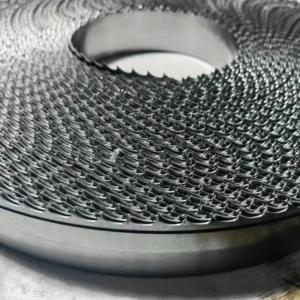
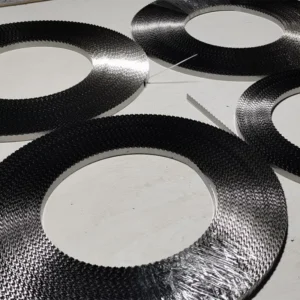
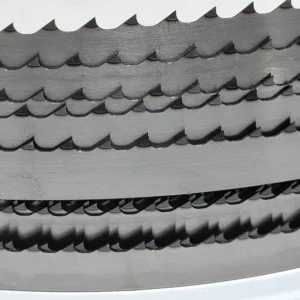
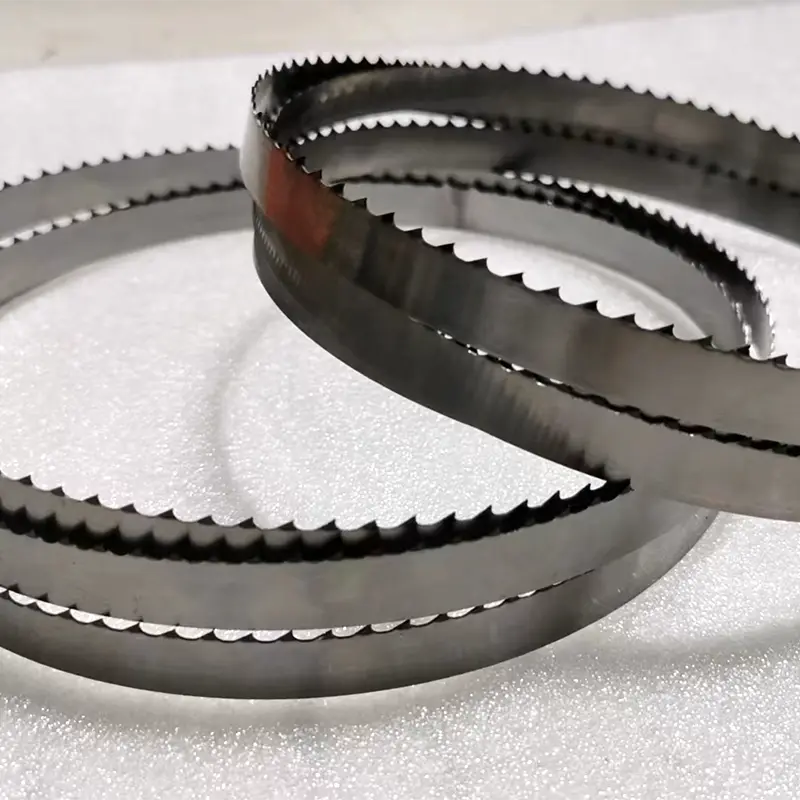
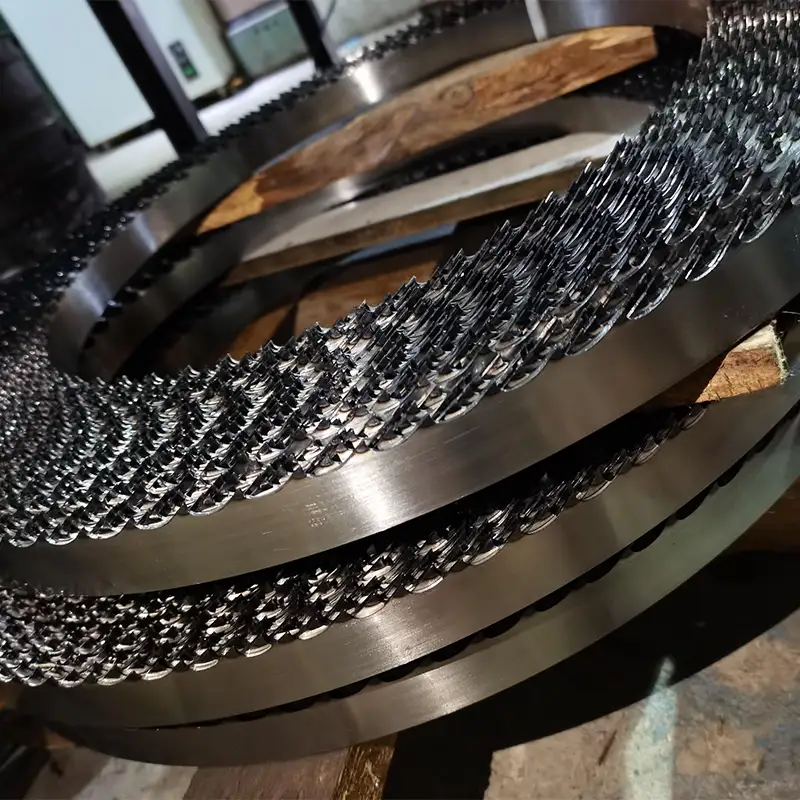
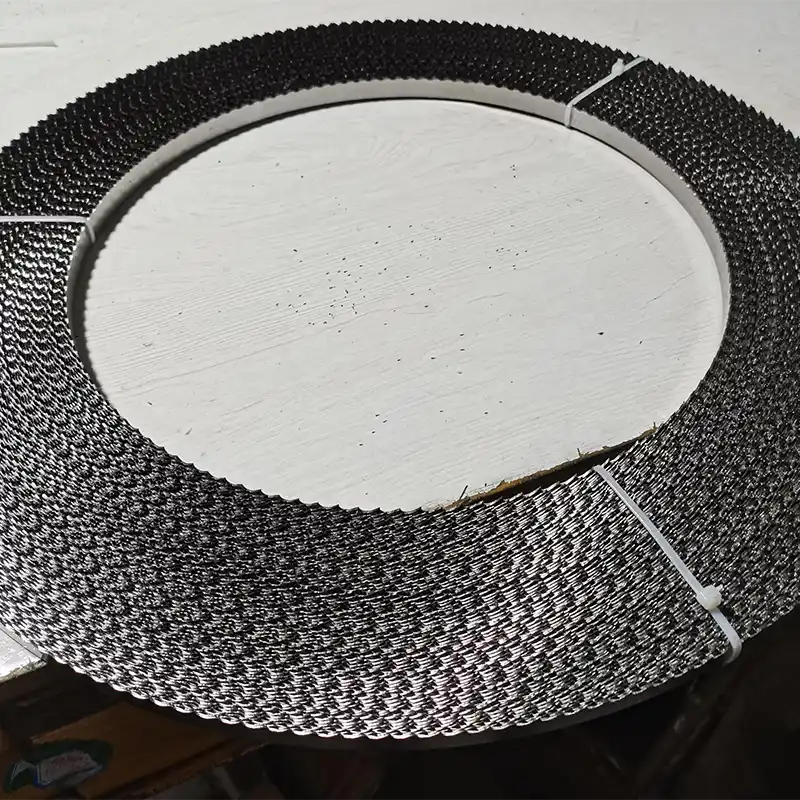
This series of metal cutting band saw blades uses a bi-metal construction. The tooth edge is made of high-speed steel (HSS), while the backing is made of spring steel alloy. The two materials are joined by electron beam welding. The tooth edge provides hardness and wear resistance, while the backing provides fatigue strength and tensile strength. This combination allows the blade to maintain sharpness and service life under high-speed cutting conditions.
The pitch range covers 2/3T to 10/14T, suitable for cutting everything from large solid round bars (over 300 mm diameter) to thin-wall tubes.
Core Specifications
| Parameter | Specification |
|---|---|
| Tooth Material | M2 / M42 / M51 High-Speed Steel |
| Backing Material | Spring Steel (46CrNiMoV series) |
| Pitch Options | 2/3T, 3/4T, 4/6T, 5/8T, 6/10T, 8/12T, 10/14T |
| Tooth Form | Variable Pitch |
| Tooth Hardness | M2: ~64–66 HRC; M42: 67–69 HRC; M51: 69–71 HRC |
| Tooth Set | Raker / Wavy Set |
| Compatible Equipment | Horizontal band saws, vertical band saws, automatic cutting lines |
2. M2 vs M42 vs M51 — Material Comparison
The most important decision when selecting a metal cutting band saw blade is the tooth material. The table below compares the three options objectively.
| Comparison | M2 HSS | M42 HSS | M51 HSS |
|---|---|---|---|
| Cobalt Content | None | 8% Co | 10% Co + High Vanadium |
| Tooth Hardness | ~64–66 HRC | 67–69 HRC | 69–71 HRC |
| Red Hardness | ~500°C | ~550°C | ~620°C |
| Recommended Cutting Hardness | ≤ 35 HRC | ≤ 45 HRC | ≤ 50 HRC |
| Suitable Materials | Carbon steel, low-carbon steel | Alloy steel, stainless steel, tool steel | High-alloy steel, titanium, high-temperature alloys |
| Market Position | Economy / entry level | Industry standard, covers ~85% of applications | Premium, for difficult-to-cut materials |
M42 is the standard choice in the metal cutting band saw blade industry. It performs well on structural steel (such as St37-2, Q235), 40Cr, 42CrMo4, tubes, profiles, and stainless steel (AISI 304, 316).
M51 increases cobalt content and adds high-vanadium carbides. Its red hardness reaches about 620°C. When cutting high-alloy steel (such as H11, D2), titanium alloys, and nickel-based alloys, M51 offers a significant life advantage. However, when cutting ordinary carbon steel (such as 45 steel, 100 mm section), M51 does not show a clear life improvement over M42, while costing about 25–30% more. It is recommended only when material hardness exceeds 35 HRC.
M2 is an earlier tooth material. It is mainly used for cost-sensitive cutting of ordinary carbon steel. Its hardness is lower than M42, and it wears faster on hard materials.
3. Pitch / TPI Selection Guide
Teeth per inch (TPI) determines how many teeth contact the workpiece, the chip clearance space, and cutting stability. Selection principles:
-
Fine pitch (high TPI, such as 10/14T) → For thin-wall tubes, small sections, and hard materials. More teeth in contact, smoother cutting, but less chip clearance.
-
Coarse pitch (low TPI, such as 2/3T) → For large solid sections and soft metals. More chip clearance, higher cutting efficiency.
-
Variable pitch → Unequal tooth spacing reduces vibration and harmonics for quieter, more stable cutting.
Pitch-to-Application Reference Table
| Pitch | Recommended Solid Section | Recommended Tube Wall Thickness | Typical Applications |
|---|---|---|---|
| 2/3T | 250–550 mm (10–22 in) | ≥ 30 mm (≥ 1.2 in) | Large forgings, large-diameter round bars |
| 3/4T | 120–350 mm (5–14 in) | 16–22 mm (0.6–0.9 in) | Thick-wall pipe, large structural steel |
| 4/6T | 60–110 mm (2.4–4.3 in) | 12–16 mm (0.5–0.6 in) | Medium solid steel, thick-wall tube |
| 5/8T | 40–70 mm (1.6–2.8 in) | 9–13 mm (0.35–0.5 in) | Medium profiles, alloy steel bars |
| 6/10T | 30–60 mm (1.2–2.4 in) | 6–9 mm (0.24–0.35 in) | General cutting, mixed sections |
| 8/12T | 20–40 mm (0.8–1.6 in) | 3–6 mm (0.12–0.24 in) | Tubes, small profiles, stainless steel |
| 10/14T | 0–25 mm (0–1 in) | 0–4 mm (0–0.16 in) | Thin-wall tube, precision cutting, small sections |
For work-hardening materials such as stainless steel, keep approximately 5–7 teeth in the workpiece at all times. Variable-pitch blades are preferred to reduce vibration.
Selection warning: If the pitch is too coarse (TPI too low), thin-wall material may cause tooth tips to catch or snag, leading to blade breakage. If the pitch is too fine (TPI too high), chip clearance is insufficient, and chip packing will accelerate tooth wear.
4. Recommended Cutting Parameters
The following are reference cutting speeds for bi-metal band saw blades based on a 4 in / 100 mm material section. For smaller sections, increase speed by about 10%. For larger sections, decrease speed by about 10%.
| Material Type | Typical Grades | Cutting Speed (m/min) | Cutting Speed (ft/min) | Coolant |
|---|---|---|---|---|
| Structural Steel | St37-2 / Q235 | 80–100 | 260–330 | Recommended |
| Quenched & Tempered Steel | 42CrMo4 / 40Cr | 50–65 | 165–215 | Recommended |
| Stainless Steel | AISI 304 / 316 | 35–45 | 115–150 | Required |
| Tool Steel | H11 / D2 | 30–40 | 100–130 | Recommended |
| High-Temperature Alloy | Inconel / Hastelloy | 20–30 | 65–100 | Required |
New blades must be broken in before use. Run at 20%–50% of normal feed rate for the first 50–75 square inches of cutting area. Proper break-in significantly extends blade life.
5. Product Advantages
-
Full Pitch Coverage — Seven variable-pitch options from 2/3T to 10/14T meet different section and material requirements.
-
Three Tooth Materials — M2, M42, and M51 allow flexible matching based on budget and material hardness.
-
Variable Pitch Design — Effectively reduces cutting vibration, improves cut surface quality, and extends blade life.
-
Wide Material Adaptability — Cuts carbon steel, alloy steel, stainless steel, tool steel, titanium alloys, and high-temperature alloys.
-
Long Service Life — Electron beam welded tooth and backing, combined with precision heat treatment, ensures the best balance of tooth hardness and backing toughness.
6. FAQ
Q1: What is the difference between M42 and M51 band saw blades? Which one should I choose?
A: M42 contains 8% cobalt with a tooth hardness of 67–69 HRC. It is suitable for materials up to 45 HRC and covers about 85% of metal cutting applications. M51 contains 10% cobalt plus high-vanadium carbides, reaches 69–71 HRC, and offers red hardness up to about 620°C. It is designed for high-alloy steel, titanium alloys, and high-temperature alloys. If you frequently cut large stainless steel parts or alloys above 35 HRC, choose M51. For ordinary carbon steel and standard alloy steel, M42 is sufficient.
Q2: Should I choose variable pitch or constant pitch band saw blades?
A: Variable pitch blades have unequal tooth spacing that breaks resonance during cutting. This reduces vibration, improves surface finish, and increases chip evacuation efficiency. They are suitable for most metal cutting operations. Constant pitch blades are mainly used for repetitive cutting of fixed cross-sections.
Q3: How do I choose the correct TPI based on material thickness?
A: The basic rule is to keep 3–7 teeth in contact with the workpiece. For thin-wall tube (wall thickness under 4 mm), choose 10/14T. For medium sections (20–60 mm), choose 6/10T or 8/12T. For large solid sections (over 100 mm), choose 3/4T or 4/6T.
Q4: What parameters should be used for cutting stainless steel?
A: Use M42 or M51 variable-pitch blades. Choose pitch from 5/8T to 10/14T depending on section size. Recommended cutting speed is 35–45 m/min (115–150 ft/min). Coolant must be used. Stainless steel work-hardens easily, so feed rate should not be too light; otherwise the surface may harden and accelerate blade wear.
Q5: How long does a band saw blade last?
A: Blade life depends on the material being cut, cutting parameters, machine condition, and maintenance. Under proper conditions, an M42 blade cutting ordinary carbon steel can achieve hundreds of cuts. Life is shorter when cutting stainless steel or high-alloy materials. Correct break-in, coolant use, and proper cutting speed are key to extending blade life.