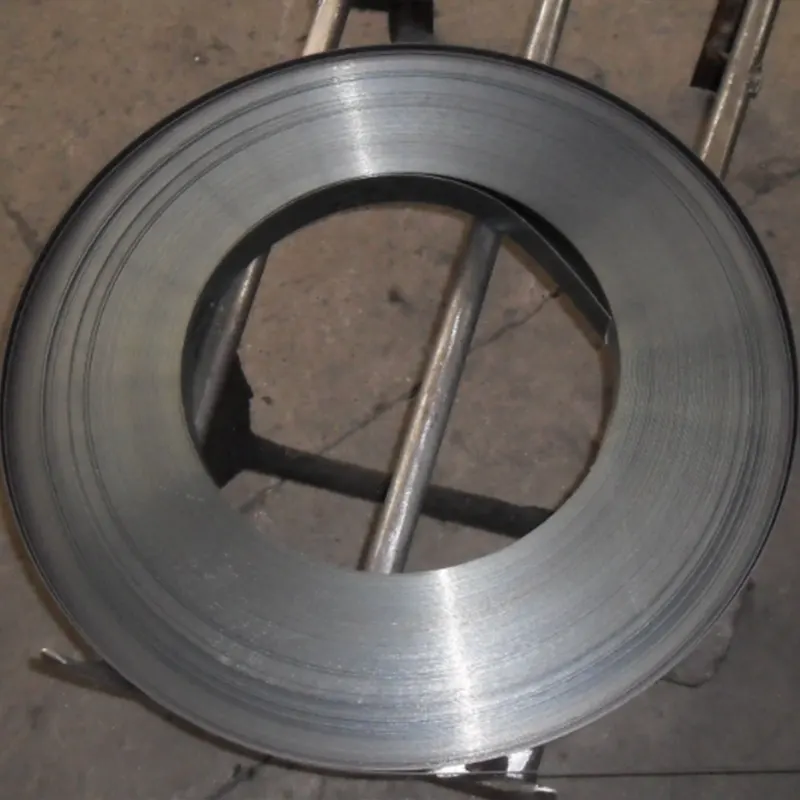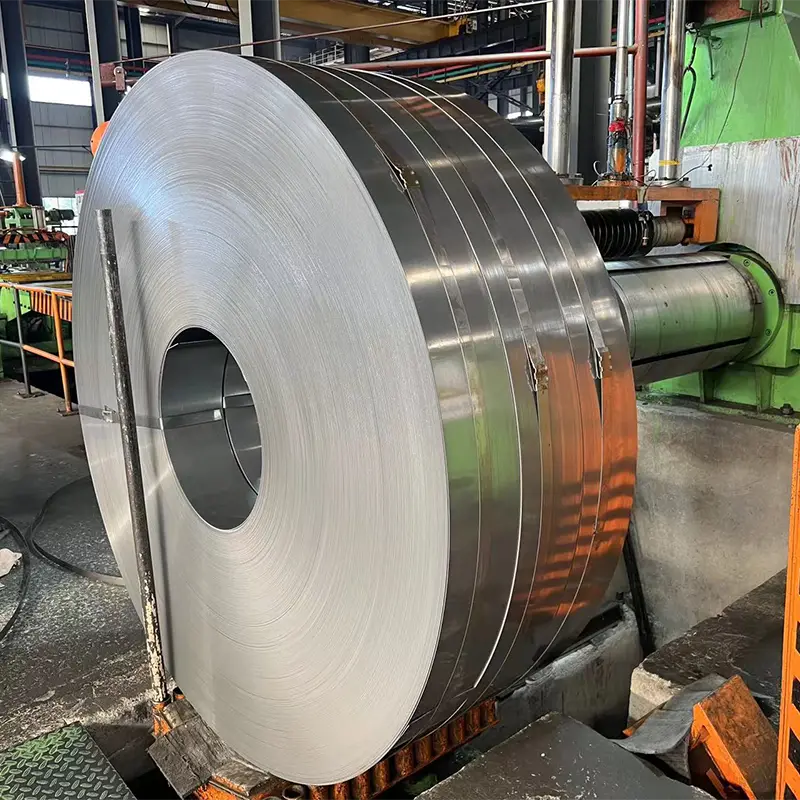
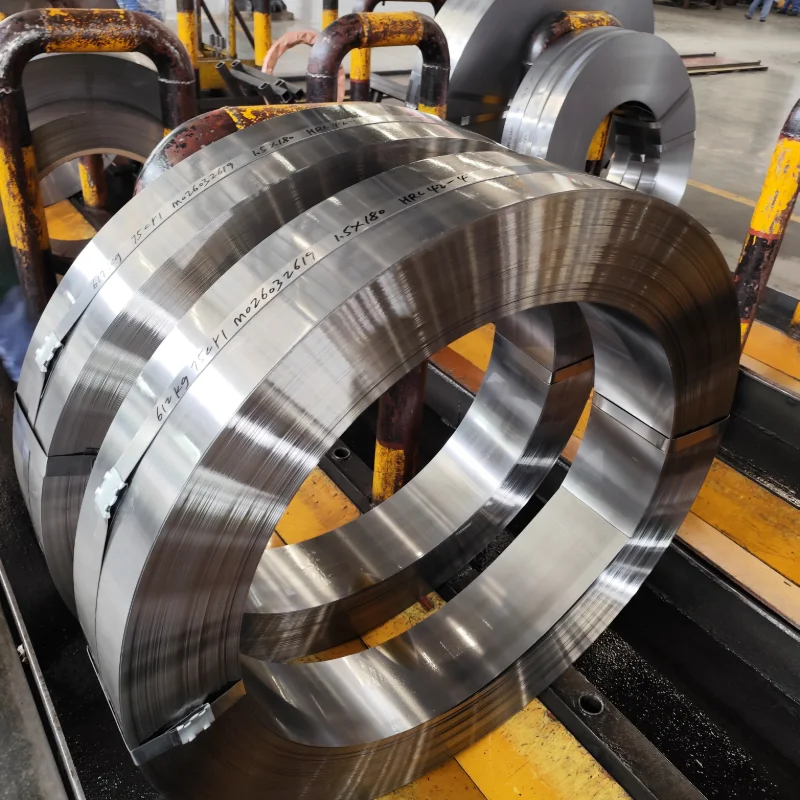
What Are CK60, CK67 and CK75 Steel Strip?
CK60, CK67 and CK75 belong to the CK series of unalloyed carbon spring/high-carbon steel strip under the European system. “CK” designates Carbon steel, *k*illed (rimmed), with the number denoting the approximate carbon content in hundredths of a percent. They are supplied as cold-rolled narrow strip in thickness ranges typically from 0.10 mm to 5.5 মিমি, and are used in applications where the strip is either (ক) stamped or formed in the annealed/soft condition and then hardened and tempered, or (b) supplied already hardened and tempered for direct service.
The three grades form acarbon ladder:
- CK60 — ~0.60% C, the lowest carbon and highest cold-formability of the three.
- CK67 — ~0.67% C, the middle grade positioned for general elasticity with toughness.
- CK75 — ~0.75% C, the highest carbon and the grade oriented toward strength and wear resistance.
This carbon gradient is the single most important selection variable because it drives hardenability, achievable hardness, forming limit, springback behavior and cracking risk in a predictable direction.
Chemical Composition and Cross-Standard Equivalents
The nominal chemical compositions below are drawn from EN/DIN technical datasheets and supplier cross-references. Ranges differ slightly between standards and producers; tighter internal tolerances are common in precision strip supply.
| Element (wt.%) | CK60 (1.1221) | CK67 / C67S (1.1231) | CK75 / C75S (1.1248) |
|---|---|---|---|
| Carbon (C) | 0.57–0.65 | 0.65–0.72 | 0.70–0.80 |
| Silicon (Si) | 0.17–0.37 | 0.15–0.35 | 0.15–0.35 |
| Manganese (Mn) | 0.60–0.90 | 0.60–0.90 | 0.60–0.80 |
| Phosphorus (P), max | 0.035 | 0.025–0.035 | 0.025–0.035 |
| Sulfur (S), max | 0.035 | 0.025–0.035 | 0.025–0.035 |
Cross-standard equivalents. CK60 ≈ AISI 1060 / SAE 1060 ≈ GB 60; CK67 ≈ AISI 1070 / SAE 1070 ≈ GB 70; CK75 ≈ AISI 1075 / SAE 1075 ≈ GB 75. In the JIS system, CK75 is commonly cross-referenced to SK6 or S75C depending on product form and heat-treatment condition.
Mechanical Properties at a Glance
The property contrast is most meaningful when compared at thesame delivery condition. The table below separates soft/annealed reference values (relevant to forming) from hardened-and-tempered values (relevant to final service).
| সম্পত্তি | CK60 | CK67 | CK75 |
|---|---|---|---|
| Annealed yield strength, approx. | Lower than CK67 | ~380 MPa | ~400 MPa |
| Annealed tensile strength, approx. | ~540–600 MPa (grade-dependent) | ~550–580 MPa | ~570–610 MPa |
| কঠোরতা, annealed | Soft, formable | ~≤180–229 HB | ~≤189–255 HB |
| Hardness after Q+T | ~45–55 HRC | ~50–58 HRC | ~55–62 HRC |
| Tensile strength after Q+T | Moderate–high | ~1,230–1,770 MPa | ~1,225–1,900 MPa |
| Forming window | Widest of the three | পরিমিত | Narrowest |
How to read this table. The annealed strength values for CK67 and CK75 are close—only tens of MPa apart—but the post-quench hardness and achievable strength diverge sharply. CK75’s higher carbon content makes it capable of higher as-quenched hardness, but it also narrows the cold-forming window. CK67 sits at the practical balance point: enough carbon for spring performance after heat treatment, but enough toughness and forming latitude for general stamping and spring coiling.
CK60 vs CK67 vs CK75: Selection Logic by Application
Choose CK60 when cold-forming margin and moderate strength are the priority
CK60 is the appropriate starting point when the part geometry is complex enough that cracking risk during stamping or bending is a real concern, or when the final service load does not justify the higher carbon grades. Its lower carbon content gives it the widest cold-forming window of the three. Typical fits include stamped brackets, general machine-construction parts, and applications where the part is subsequently hardened and tempered to a moderate strength level rather than maximum hardness.
CK60 is also a practical choice when welding or joining is part of the fabrication route. While none of the CK high-carbon grades is considered readily weldable, CK60 has a comparatively better position than CK67 or CK75; for welded assemblies, a lower-carbon or alloy alternative should still be evaluated rather than defaulting to a CK grade.
Choose CK67 when you need the elasticity–toughness balance
CK67 is the general-purpose spring and precision-stamping grade of the three. Its carbon level is high enough to develop useful spring properties after quenching and tempering, but low enough to retain more toughness and forming latitude than CK75. Supplier selection guides consistently position CK67 as the grade for general springs, clips, stampings sensitive to cracking, and narrow strip parts requiring some forming allowance.
A property advantage that is easy to overlook: CK67 offers a low yield point combined with non-aging characteristics, which helps reduce springback variation and performance drift during storage in precision stamping. For progressive-die processes where dimensional consistency and feeding stability matter as much as absolute strength, this can make CK67 the more robust production choice than a higher-carbon grade.
Typical application signals for CK67 include: spiral springs, agricultural tools, band-saw blades, seat springs, pressure-regulating springs, and small valve springs—components that need reliable elastic recovery without the brittleness risk of a 0.75% C grade in thin sections.
Choose CK75 when strength, hardness and wear resistance dominate the service condition
CK75 is the grade for high-load, high-wear applications where the part will either be used in the hardened-and-tempered condition or must deliver high elastic recovery force. Its higher carbon content produces superior hardness after quench and temper, and correspondingly better wear resistance. Supplier positioning describes CK75 as emphasizing strength and wear resistance, in contrast to CK67’s emphasis on elasticity and toughness.
Typical fits for CK75 include flat springs, cutting tools, saw blades, band-saw blade blanks, hand tools, rolling-shutter springs, and diaphragm springs. In the watch and electronics industries, thin CK75 strip is used for stamped parts with high mechanical requirements and cutting tools.
The trade-off is explicit: higher carbon generally means a narrower forming window. In complex progressive dies, CK75’s cracking risk should be assessed together with edge quality and lubrication strategy, not treated as a drop-in substitute for CK67 or CK60. CK75 is also not the right grade when significant cold forming is required after the final heat treatment—in most applications at this carbon level, the part either enters service directly in the hardened-and-tempered condition or requires careful annealing between forming steps.
How to Select the Right Grade: A Step-by-Step Method
The following sequence reflects the variables that matter in actual strip specification. It is presented as a decision procedure rather than a single “answer,” because grade selection is a constraint-satisfaction problem, not a ranking exercise.
Step 1 — Define the forming route before the service property.
Ask: Is the part formed from annealed strip and then heat-treated, or supplied pre-hardened? If the forming route involves significant bending, coining or progressive-die operations, start from the lowest carbon grade that can meet the service strength after heat treatment, not from the highest strength grade available. CK75’s property advantage is irrelevant if the part cannot be formed without cracking.
Step 2 — Match the grade to the dominant service demand.
- If the dominant demand is elastic recovery under moderate load → CK67.
- If the dominant demand is high hardness / wear resistance → CK75.
- If the dominant demand is cold-formability and moderate strength → CK60.
This mapping is consistent across supplier selection guides and standard application notes.
Step 3 — Check the heat-treatment route and achievable hardness.
CK60 and CK67 are typically quenched and tempered to intermediate hardness ranges; CK75 is chosen when the target hardness is in the high 50s to low 60s HRC and the section is thin enough for through-hardening. If the required hardness is beyond what the carbon level can deliver in the available section size, the correct response is to consider an alloyed grade (such as a Cr-containing spring steel) rather than over-specifying CK75 for a section it cannot harden uniformly.
Step 4 — Lock in edge condition, tolerance and surface quality.
In precision strip, edge quality and thickness tolerance can affect die life, feeding stability and scrap rate more directly than the grade itself. For CK75 especially, a deburred or rounded edge reduces the risk of edge-initiated cracking during stamping and feeding. Thickness tolerances under EN 10140 for narrow cold-rolled strip can reach the order of ±0.010–0.015 mm in favorable width ranges, but the achievable tolerance depends on thickness, width and order quantity and should be specified explicitly in the RFQ.
Step 5 — Validate with trial stamping or springback simulation.
Final selection should combine springback simulation, die clearance design and trial stamping validation. Carbon content alone does not predict forming outcome in a specific die; lubrication, edge condition and strip flatness interact with the grade. This validation step is especially important when moving from CK67 to CK75 in an existing progressive die.
Quality and Specification Considerations for CK75 Steel Strip
Because CK75 is the most carbon-rich of the three, it is also the grade most sensitive to surface decarburization and banded microstructure if hot-rolling and heat-treatment atmospheres are not controlled. Decarburization at the strip surface lowers local hardenability and can produce soft spots or premature fatigue initiation in springs and cutting edges. Reputable hardened-and-tempered strip suppliers control furnace atmospheres to prevent oxidation and decarburization, and specify decarburization depth ≤1% of strip thickness where surface integrity is critical.
For CK75 in the annealed condition, the deliverable hardness is typically controlled to a maximum around ≤190–255 HB depending on producer and condition, so that the strip can be stamped or formed before hardening. In the hardened-and-tempered condition, CK75 strip is available across a hardness range from approximately 35 HRC to 55–62 HRC, with tensile strength correspondingly ranging from roughly 1,100–1,300 MPa up to 1,500–1,800 N/mm² in the harder tempers.
These ranges arecondition-dependent, not grade-constant. A specification that states only “CK75” without the delivery condition (annealed, ¼ hard, hard, extra hard, or Q+T to a target hardness) is incomplete for procurement and should be treated as an open question in supplier qualification.
প্রায়শই জিজ্ঞাসিত প্রশ্নাবলী
What is the difference between CK67 and CK75 steel strip?
The primary difference is carbon content: CK67 contains approximately 0.65–0.72% C, while CK75 contains approximately 0.70–0.80% C. CK67 is positioned for a balance of elasticity and toughness, making it suitable for general springs and stampings sensitive to cracking. CK75 is positioned for higher strength, hardness and wear resistance, making it suitable for high-load springs, cutting tools and saw blades. The practical consequence is that CK75 has a narrower cold-forming window and is more sensitive to edge quality and forming parameters.
Can CK75 be used in the annealed condition without heat treatment?
হ্যাঁ, CK75 can be supplied annealed for forming, but the annealed condition does not deliver the high strength and hardness associated with the grade. Annealed CK75 typically has hardness in the range of roughly ≤190–255 HB and tensile strength around ≤640 MPa, depending on producer and condition. The high-strength properties (যেমন, 1,225 MPa+ tensile, 50–55 HRC) require quenching and tempering after forming. Specifying CK75 annealed and expecting spring-grade performance without a subsequent heat treatment is a common specification error.
Is CK75 the same as AISI 1075?
CK75 (IN 1.1248, C75S) is approximately equivalent to AISI/SAE 1075 in carbon and manganese range, and the two are commonly cross-referenced in procurement. They are not identical in every respect—European CK75 may carry tighter phosphorus and sulfur limits, and “C75S” specifically denotes a spring-quality variant. For material substitution, the numeric material number 1.1248 and the delivery condition should be confirmed, not just the AISI cross-reference.
Which grade is best for a rolling shutter spring?
CK67 and CK75 are both used for rolling-shutter springs, but they serve different load regimes. CK67 is the general-purpose choice where toughness and fatigue life under moderate load are prioritized. CK75 is selected when higher strength and wear resistance are needed, typically in the hardened-and-tempered condition. The final choice should be validated against the spring’s stress amplitude, required cycle life and the strip’s edge condition.
What does “narrow forming window” mean for CK75 in practice?
It means that CK75 toleratesless bending, stretching and die-filling deformation before cracking compared with CK60 or CK67. In a progressive die, this can show up as edge cracking, increased burr sensitivity, or a need for tighter die clearance and better lubrication. The practical response is not necessarily to avoid CK75, but topair it with deburred or rounded edges, validate the forming sequence by trial stamping, and consider whether the part can be formed in a softer condition and hardened afterward rather than being formed in the hardened state.