Quick Answer
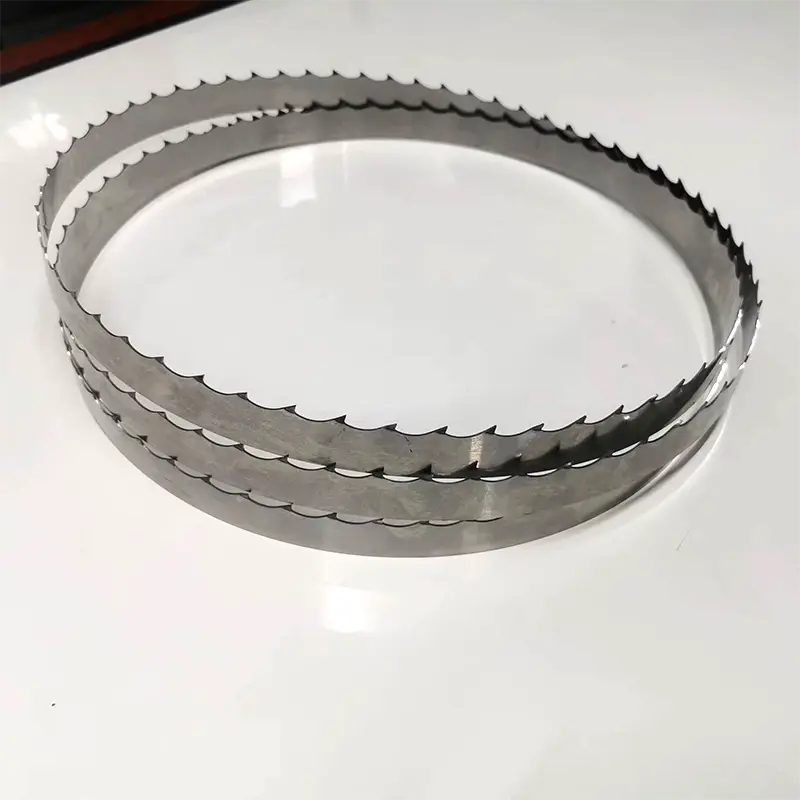
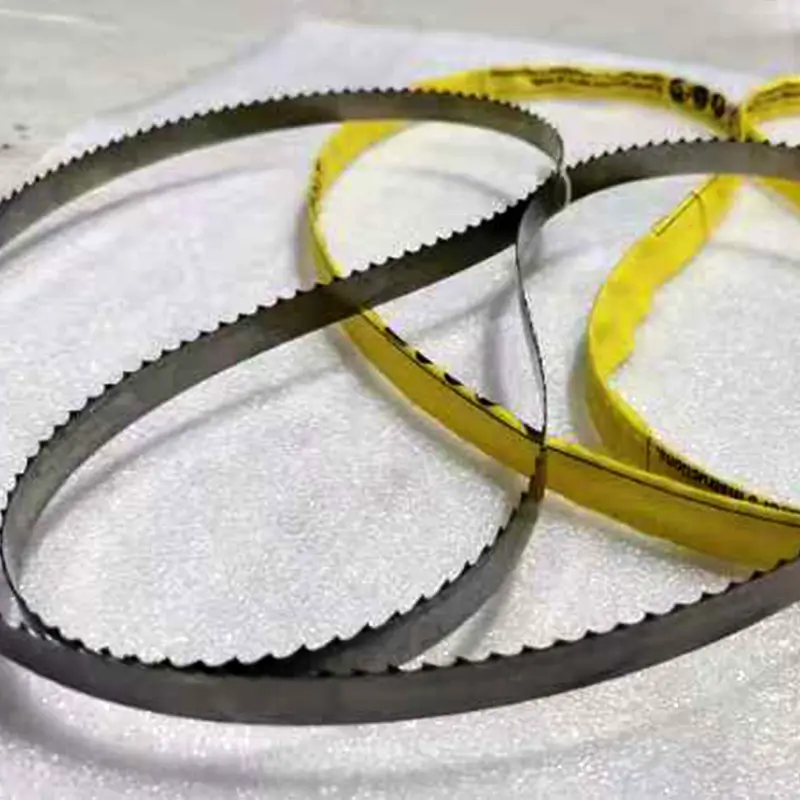
Meat & bone cutting band saw blades are endless loop blades designed for vertical meat band saws used in slaughterhouses, meat processing plants, supermarket meat counters, and commercial kitchens. They are made from high-carbon tool steels such as C75, C75Cr1, SK5, and SK4. Choose 3TPI for frozen meat, large bone-in cuts, and high-volume production; choose 4TPI for fresh meat, lighter bones, and cleaner cuts. Custom lengths, CE certification, SGS reports, MOQ 10 m.
What Are These Blades?
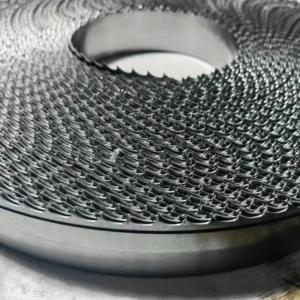
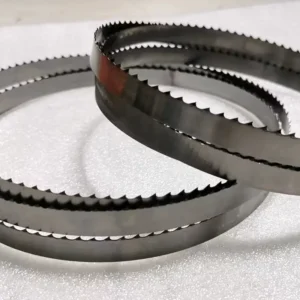
Meat & bone cutting band saw blades are circular loop cutting tools mounted on vertical band saw machines. They cut fresh meat, frozen meat, bone-in cuts, and fish through a continuous high-speed loop motion.
This product is made from food-grade high-carbon tool steel — C75 / C75Cr1 / SK5 / SK4 — precision rolled and induction hardened at the tooth tip. Tooth hardness reaches 62–67 HRC, delivering high wear resistance and fatigue resistance. Every finished blade is joined into a loop by computer-controlled flash butt welding, followed by localized induction annealing to restore toughness at the weld zone and prevent brittle fracture.
Key Benefits
| Feature | Specification |
|---|---|
| Material | Food-grade high-carbon / alloy tool steel, suitable for food-contact applications |
| Tooth Tip Hardness | 62–67 HRC (induction hardened) |
| Blade Body Hardness | 44–50 HRC, balancing strength and flexibility |
| Welding | Computer-controlled flash butt welding + localized induction annealing; smooth, burr-free weld joint |
| Cutting Loss | Narrow kerf design reduces meat waste by approximately 10–15% compared with standard blades |
| Certification | CE certified; SGS test reports available per batch |
| Customization | OEM/ODM for any length, width, tooth pitch, and tooth form |
Four Core Steel Grades
C75 (1.0605 / CK75)
C75 is a classic high-carbon tool steel with a carbon content of 0.70–0.80%. Its main advantage is high bending fatigue strength, making it suitable for medium-to-low speed continuous cutting. It performs reliably on fresh meat and light bone-in cutting. After hardening, C75 teeth can reach approximately 62 এইচআরসি. It offers strong cost-performance and is a mainstay choice for entry-level to mid-range slaughter lines.
C75Cr1 (1.2003 / 75Cr1)
C75Cr1 is an alloy tool steel based on C75 with added chromium (0.30–0.60%). It has a tensile strength of ≥1300 MPa and can reach 58–64 HRC after quenching. The chromium addition significantly improves wear resistance and resistance to temper softening, making it better suited for cutting high-density bones such as beef bone and pork leg bone. In frozen meat cutting, the service life of C75Cr1 is typically about 30% longer than ordinary carbon steel blades.
SK5 (JIS G4401)
SK5 is a Japanese-standard carbon tool steel with a carbon content of 0.80–0.90% and manganese controlled at 0.10–0.50%. SK5 is known for excellent tooth shape retention — after high-frequency quenching and low-temperature tempering, the tooth tip stays sharp during extended use, reducing blade change frequency. For operations that prioritize cutting efficiency and clean cut surfaces, SK5 is an ideal choice.
SK4 (JIS G4401)
SK4 is a Japanese-standard carbon tool steel with a higher carbon content than SK5, typically 0.90–1.00% C. This gives SK4 higher hardness and wear resistance, but slightly lower toughness than SK5. It is suitable for high-wear cutting of frozen meat and fish bones when the machine runs at stable feed and proper tension. For shock-prone manual feed or mixed bone density, SK5 is often the safer balanced choice.
3TPI vs 4TPI: Tooth Pitch Selection Guide
Tooth pitch (TPI = teeth per inch) is the most important parameter affecting blade performance.
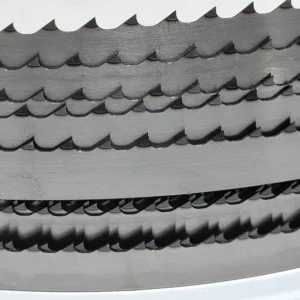
3TPI — Large Pitch, Strong Chip Clearance
-
Best for: Beef quarters, pork shoulders, large bone-in cuts; frozen meat blocks (below -18°C); ice blocks; high-volume production lines
-
Advantages: Large gullets efficiently clear bone chips and fat debris, reduce heat buildup in the cutting zone, and provide stronger durability under high feed rates
-
Note: Rougher cut surface; visible tooth marks may appear on soft meat
4TPI — Balanced Choice, Cleaner Cut
-
Best for: Fresh and chilled meat; light bone content; boxed meat cutting; retail display meat; poultry portioning
-
Advantages: More teeth in contact with the product produce smoother cuts, less tearing of soft tissue, and a cleaner presentation surface
-
Note: Service life drops faster under heavy bone cutting and frozen conditions; not recommended as the primary blade for high-intensity frozen cutting
Selection rule: Large cuts, frozen, heavy bone → 3TPI; Small cuts, fresh meat, appearance-critical → 4TPI.
Typical Specifications
| Parameter | Range |
|---|---|
| Width | 13 mm / 16 mm / 19 mm (5/8″ / 3/4″) |
| Thickness | 0.50 mm / 0.56 mm (.020″ / .022″) |
| Tooth Pitch | 3TPI / 4TPI / 6TPI |
| Length | 1200 mm – 4050 mm (custom lengths available) |
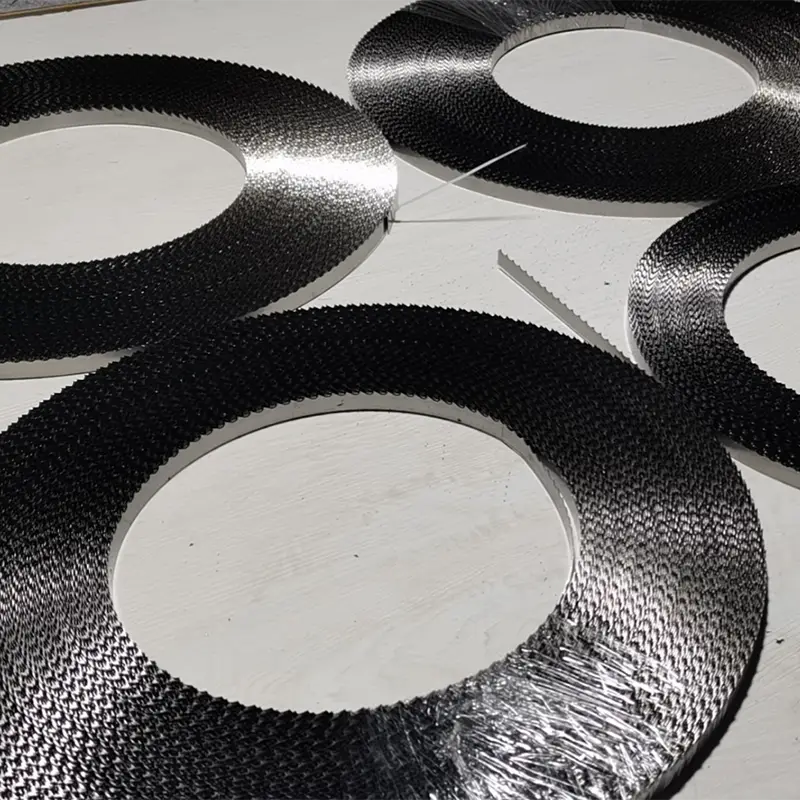
| Supply Form | Welded endless loops / 100 m coils / cut-to-length coils |
Common finished lengths include 1650 mm, 1840 mm, 2240 mm, 2485 mm, and 3150 mm, covering mainstream band saw machine models such as Biro, Hobart, Torrey, and Butcher Boy.
Manufacturing Process & Quality Control
-
Tooth Forming & Setting: Precision grinding; tooth pitch tolerance controlled within ±0.1 mm for even cutting load distribution.
-
High-Frequency Induction Hardening: Only the tooth tip is locally hardened while the blade body remains tough. Tooth tip hardness: 62–67 HRC; blade body hardness: 44–50 HRC — a “hard tooth, tough body” combination.
-
Flash Butt Welding: Computer-controlled flash butt welding with automatic control of welding current, upset force, and annealing temperature. Localized induction annealing after welding restores flexibility at the weld zone and prevents brittle fracture.
-
Weld Finishing: The weld joint is ground, straightened, and deburred to ensure smooth running and no abnormal noise.
-
Anti-Rust Treatment: Each coil or blade is coated with food-grade anti-rust oil and vacuum-packed, then placed in high-strength cartons or fumigation-free wooden cases. Sea freight rust protection: ≥60 days.
Applications
-
Slaughterhouses: Beef quartering, pork carcass splitting, lamb carcass cutting
-
Meat Processing Plants: Boning, portion cutting, trimming, frozen block slicing
-
Supermarkets & Meat Counters: Retail cutting, bone-in rib sawing, display meat shaping
-
Poultry Processing: Whole chicken/duck portioning, wing and leg separation
-
Seafood Processing: Frozen fish steak